

Improv Arena Review: Is Up to US$35 an Hour for Reading Cantonese Scripts Worth Licensing Your Voice?
Improv Arena reviewed for Hong Kong residents: the operator, how pay per hour of accepted audio works, realistic earnings for the Cantonese role, microphone and application requirements, the AI voice licence, cashing out through Tremendous, account bans and disputes, user ratings and who should avoid it.
Last updated 27 October 2026

Best for
Native Cantonese speakers living in Hong Kong who already own a USB microphone and a quiet room, want modest, flexible earnings in US dollars, and accept their voice being licensed to AI companies for training and voice cloning.
Improv Arena pays for real work, but its published rate is a ceiling. Pay is calculated per hour of accepted audio: up to US$35 (about HK$272) for the Cantonese role in Hong Kong, so 20 accepted minutes, or 80 clean 15-second takes, is worth about US$11.67 (about HK$91). Reading prompts, preparation, retakes and rejected takes are unpaid, so actual earnings per hour of effort are lower. The more significant cost is the voice itself: before earning a single coin, users must agree that Luvu, Inc. may license or sell their recordings, voiceprint, age, gender and approximate location to AI companies for model training, synthetic voices and voice cloning, and licensed data cannot be recalled. There is no sign-up bonus. Those who accept these terms should cash out at the first US$3 to US$5 to confirm that payment works, record alone on a single account and avoid accumulating a large balance.
Pros
- No fee, deposit or acting experience required; short lines are read from home at any time
- A published ceiling for the Cantonese role of US$35 (about HK$272) per hour of accepted audio
- A low cash-out minimum of US$3 to US$5, claimed through Tremendous as PayPal or a gift card
- League bonuses of 15%, 30% or 50% on every take as recordings improve
- A Traditional Chinese interface, with each take scored immediately
- Operated by Luvu, Inc., a US app company whose TinyStage app rates 4.3 from about 15,700 Google Play ratings
Watch-outs
- Earning requires licensing the voice, voiceprint, age, gender and location to AI companies, including for voice cloning
- Only accepted audio is paid; preparation, retakes and rejected takes earn nothing
- The Cantonese role requires a USB or studio microphone on a stand; without confirmation only the lower standard rate applies
- Recent App Store reviews report balances suspended over "multiple voices", unpaid takes and unanswered support requests
- Recording time is capped, and some users report that tasks run out
- Payouts are in US dollars, and converting them to Hong Kong dollars through PayPal incurs an exchange spread
Current related offer
Improv Arena offer pageAd / referral links — we may earn a bonus when you sign up.
Provider
Improv Arena
Native Cantonese speakers living in Hong Kong can join Improv Arena with code 55PNHS and be paid in US dollars to record short script lines, at up to US$35 (about HK$272) per hour of accepted audio. There is no sign-up bonus, and earning requires licensing one's voice to AI companies, including for voice cloning.
Requirement: No purchase or deposit. Applicants must be 18 or over, native Cantonese speakers living in Hong Kong, and record in a quiet room with a USB or studio microphone on a stand
MediumAbout 10 minutes to register, including a 3-minute recording application; each scene takes about 15 secondsPayout Each take is scored on completion. Cash out once the in-app minimum (currently US$3–5) is reached; after Improv Arena approves it, Tremendous emails a link to claim the US dollars by PayPal or as a gift card.
Verified 27 October 2026
Full claim instructions are on the Improv Arena offer page.
What Improv Arena is
Improv Arena (improvarena.com) is a website that pays native speakers to record short script lines in their own language. It is the web version of TinyStage: Voice Act Rewards, an iPhone and Android app launched in June 2026; both run on the same backend under the same terms and are operated by Luvu, Inc., a Delaware company based in Pittsburgh that also publishes the Luvu home-workout app. Users with an existing TinyStage account must cash out in the TinyStage app.
The main task is "Read scripts": a line of about 15 seconds appears with a direction such as "angry and fed up", the user records it, and the take is scored immediately. Optional work includes rating other users' takes and transcribing clips word for word, both listed at US$20 an hour, as well as short voice conversations with other users. Luvu states the business model plainly in its terms: it collects voice data and licenses or sells it to AI companies, and coins are the compensation for that data.
How pay is calculated
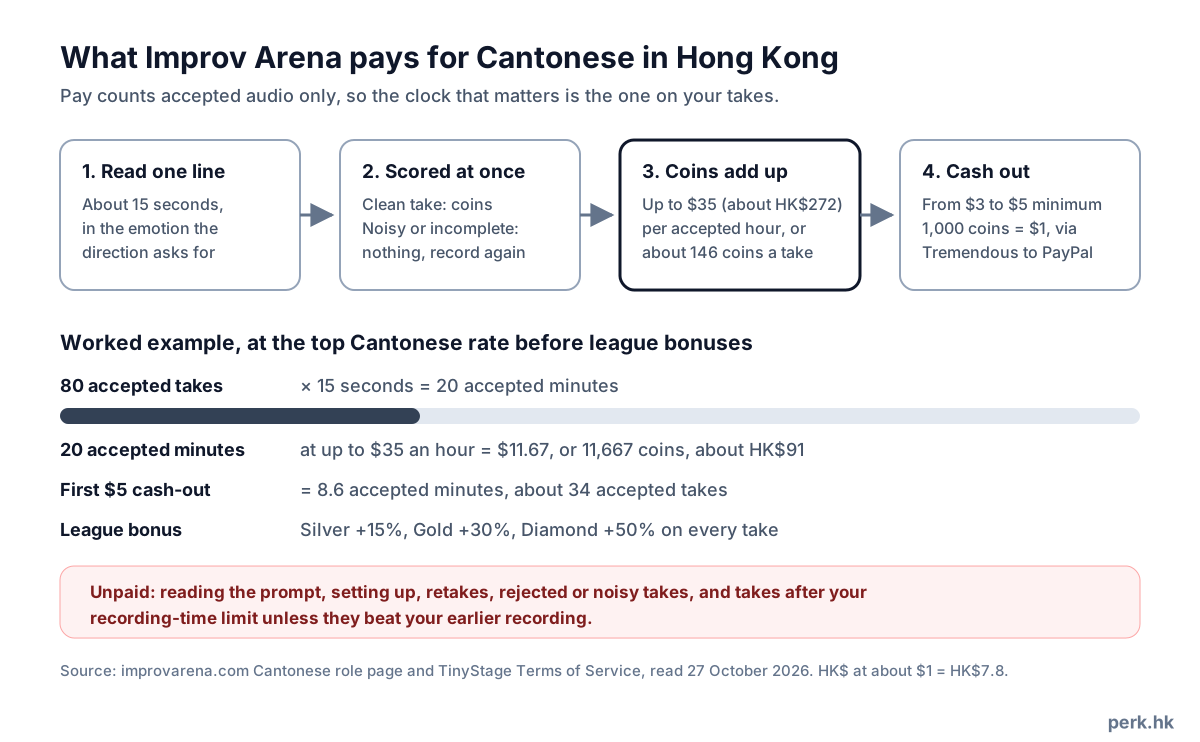
Every role lists an hourly ceiling in US dollars, and that hour counts accepted audio only, not preparation time. The Cantonese role in Hong Kong pays up to US$35 an hour; the site converts it at the live rate and rounds down, so Hong Kong visitors see about HK$272. Coins are the unit of account: 1,000 coins equal US$1, so a clean 15-second take at the top Cantonese rate is worth about 146 coins. Pay depends on quality: clean takes earn the most, weaker takes less, and a take that is too noisy or omits part of the script earns nothing and must be re-recorded.
Two factors raise pay. Leagues add bonus cash to every take: 15% at Silver, 30% at Gold and 50% at Diamond. A professional microphone confirmed by the app (a USB or studio microphone on a stand) earns up to 25% more per take than the standard rate. Two factors lower it: after reaching the recording-time limit, further takes are paid only when they improve on earlier recordings, and the volume of work depends on demand for the language. Improv Arena does not publish the time limit.
Realistic hourly earnings
At the top Cantonese rate and before any league bonus, 20 accepted minutes equals 80 clean 15-second takes and pays US$11.67, about HK$91. A first US$5 (about HK$39) cash-out requires about 8.6 accepted minutes, or about 34 takes. These are minutes of finished audio, not minutes spent at the desk.
Around each 15-second take the user reads the line and direction, records, sometimes listens back and redoes failed takes. If only a third of a session becomes accepted audio, an hour at the desk earns about US$11.67, roughly HK$91. The published ceiling is useful for comparing languages and valuing a clean take; it is not what the clock will show.
Roles open to Hong Kong residents
Roles are set by native language and place of residence. Native Cantonese speakers living in Hong Kong qualify for the Cantonese role; the English roles are listed for residents of the United Kingdom, the United States, Australia, New Zealand, Canada and India, and the Taiwanese Mandarin role for residents of Taiwan. The site accepts applications in any language but only offers work for the roles it lists. For comparison, British and American English pay up to US$40, Japanese US$40, Korean and Taiwanese Mandarin US$35, German in Germany €80, Swiss German CHF 84, and Filipino and Hindi US$10.
The share message displays the rate in the sender's local currency, so an invitation sent from Taiwan reads "up to $1,104 an hour". That figure is in New Taiwan dollars, about US$35, the Taiwanese Mandarin rate, not US dollars. Hong Kong readers should rely on the Cantonese role's US$35 (about HK$272).
Preparation before starting
Applicants must be 18 or over, native speakers of the role's language, and have a computer or phone with internet access, a quiet room and a microphone. The Cantonese role page asks for a USB or studio microphone on a stand, such as a Blue Yeti or a Shure. Onboarding asks for the best available microphone: if a professional microphone cannot be confirmed, applicants may still be accepted with wired headphones or earphones with an in-line microphone at the standard rate. A laptop's built-in microphone or Bluetooth earphones will not pass the professional check, and noise-suppression software such as Krisp is treated as a virtual microphone.
Registration takes about ten minutes, including a three-minute application: a 15-second silence check, which restarts at any noise, followed by two short reads, one "clear and natural" and one "angry and fed up". Where the app cannot confirm a professional microphone immediately, it usually responds within two days. The site offers a Traditional Chinese interface. Improv Arena verifies age before paying, and some reviewers report being flagged because a higher voice was judged to be under 18.
The voice licence
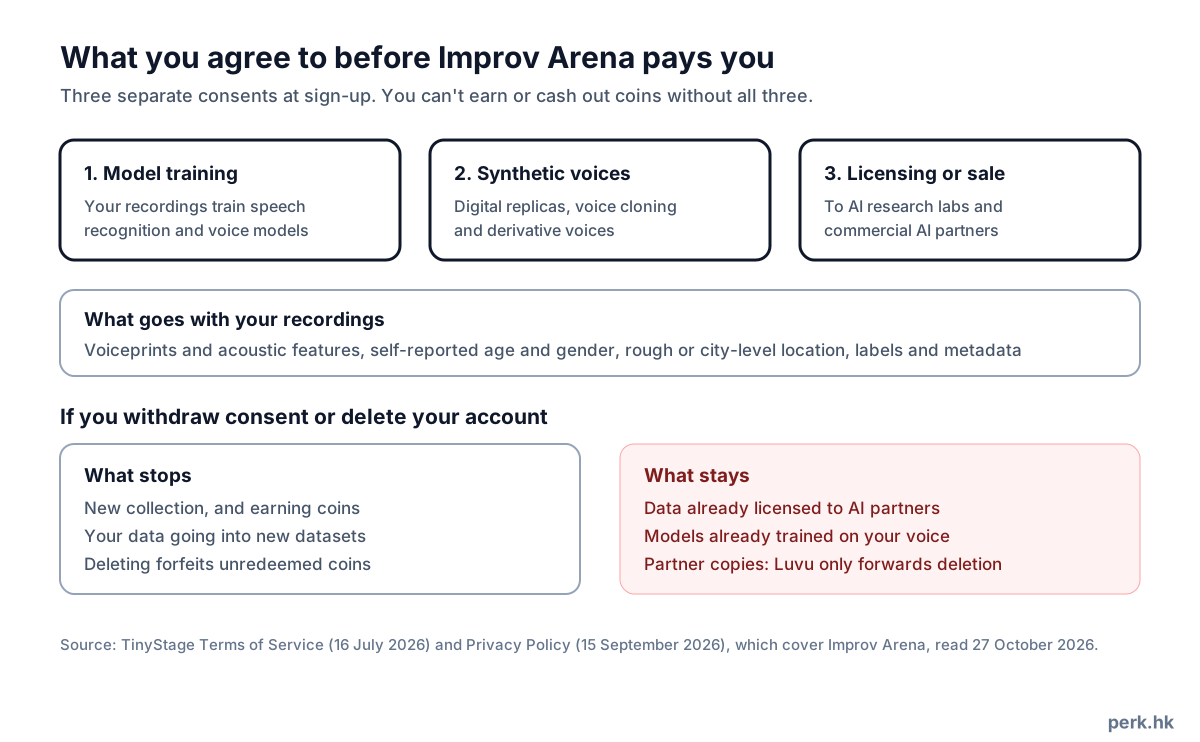
This is the section to read before joining. During registration users give three separate consents: to model training, to synthetic voice and Digital Replica use, and to the licensing or sale of their data to AI Partners. The terms make all three a condition of paid recording and of cashing out. Luvu may license or sell recordings, voiceprints and derived acoustic features, self-reported age and gender, approximate or city-level location, labels and metadata; AI Partners may use them to train speech recognition, text-to-speech, voice cloning, synthetic voices and digital replicas.
Users may withdraw consent or delete their account at any time. Doing so stops new collection, keeps recordings out of new datasets and pauses coin earning. However, recordings already licensed to an AI Partner are not recalled, and models already trained on the voice cannot be untrained; Luvu forwards deletion requests to partners only where the law or its contract requires. Deleting the account forfeits unredeemed coins. Biometric data is destroyed no later than three years after the last interaction. Recordings also pass through Luvu's processors for transcription and scoring: OpenAI, Google Cloud, Microsoft, Deepgram, ElevenLabs and Hugging Face. Professional voice artists, and anyone unwilling to see a copy of their voice exist, should not join.
The invitation and our disclosure
Joining through our link opens a standard account: Improv Arena offers no bonus to invited users, and all earnings come from the user's own recordings, ratings and transcriptions. Open the link in the browser that will be used to register; it stores code 55PNHS and carries it into sign-up. If onboarding asks what brings you here and the code is not shown, choose the referral-code option and enter 55PNHS.
Disclosure: the link and code 55PNHS are our invitation. When a user cashes out money they have earned, Improv Arena adds a matching amount to our balance, subject to a weekly cap. That amount is paid by Improv Arena and is not deducted from the user's earnings, which is also why the scheme checks that each invited person has a different voice.
Cashing out
Once the balance exceeds the minimum shown in the app, which the terms place between US$3 and US$5, the user requests a cash-out in Rewards and enters an email address. After Improv Arena approves it, sometimes following a check of the recordings, the payout service Tremendous emails a link from which the user chooses how to receive the money, such as PayPal or a gift card; the options depend on the country. All amounts are in US dollars, and a Hong Kong PayPal account converting them to Hong Kong dollars incurs PayPal's exchange spread.
Cashing out early is advisable. A first small cash-out confirms that payment works for the account and email address before many hours are invested, and money that has left the app cannot be affected by a later suspension. Check the email address carefully; the app suggests corrections for likely typing errors.
Account bans, withheld coins and disputes
The terms give Luvu broad power to adjust, withhold, revoke or cancel coins and payouts for reasons including fraud or abuse, automated or AI-generated submissions, manipulation, an ineligible region or age, and other compliance grounds. Only the account holder may record on the account; the app warns that if someone else keeps recording there the account may be banned, and a banned account cannot cash out. Coin balances and scores are determined on Luvu's servers, and the terms offer no formal appeal.
The terms are governed by Pennsylvania law, with disputes heard by the courts of Allegheny County after a written notice to [email protected] and a 60-day attempt at informal resolution. The additional protections the terms give consumers in the United Kingdom, the European Economic Area and Switzerland, such as human review of automated decisions, do not extend to Hong Kong. The scheme is also not offered in Illinois.
User ratings
On 27 October 2026 TinyStage scored 4.3 from 15,733 ratings on Google Play, with more than 100,000 downloads, and 4.7 from 559 ratings on the US App Store; the Hong Kong App Store showed a single one-star rating. Recent written reviews are harsher than the averages: of the 24 latest US and UK App Store reviews, 14 gave one star. Positive reviews describe the app as enjoyable and confirm that it pays, in some cases within minutes of cashing out.
Complaints recur: balances suspended or accounts banned over "multiple voices" or multiple accounts the reviewers say they did not have; voices judged to be under 18; takes that scored well but earned nothing; cash-outs that took days or did not arrive; in-app messages to support left unanswered; tasks disappearing behind "coming soon" screens; glitches and lost progress; and objections to the AI voice licence. These match the powers set out in the terms, so users should plan accordingly: one person, one account, early cash-outs.
Who it suits and who should avoid it
It suits native Cantonese speakers living in Hong Kong who already own a USB microphone and a quiet room, want small, flexible earnings in spare moments, and have read and accepted the AI voice licence. Those who enjoy reading lines with feeling and treat the income as pocket money rather than wages are most likely to find it worthwhile.
It does not suit professional or aspiring voice artists, anyone who would object to a cloned or synthetic version of their voice, anyone who shares a recording space or account, or anyone who needs dependable hourly pay: accepted-audio pay, recording caps and fluctuating work make it no substitute for employment. Under-18s cannot take part.
FAQ
- Is Improv Arena legitimate?
- It is a genuine service operated by Luvu, Inc., a US company, and users report receiving cash-outs. What users sell is voice data: earning requires licensing recordings to AI companies, including for voice cloning, and the terms allow Luvu to withhold coins on suspicion of fraud.
- Is there an Improv Arena sign-up bonus?
- No. Joining through our link or code 55PNHS opens a standard account; earnings come from accepted recordings, ratings and transcriptions.
- How much does the Cantonese role pay?
- Up to US$35 (about HK$272) per hour of accepted audio, plus league bonuses of 15% to 50%. Twenty accepted minutes at the top rate pays about US$11.67, roughly HK$91. Preparation and failed takes are unpaid.
- Why did the invitation say up to $1,104 an hour?
- The share message shows the rate in the sender's local currency. $1,104 is in New Taiwan dollars, about US$35, the rate for Taiwanese Mandarin speakers living in Taiwan.
- How is Improv Arena related to TinyStage?
- Improv Arena is the web version of the TinyStage app, operated by Luvu, Inc. on the same backend and under the same terms. TinyStage accounts cash out in the TinyStage app.
- Is a professional microphone required?
- The Cantonese role asks for a USB or studio microphone on a stand. Without confirmation, applicants may still be accepted with wired headphones at the standard rate; a confirmed professional microphone earns up to 25% more per take.
- Can I record in English or Mandarin from Hong Kong?
- The English roles are listed for residents of the UK, the US, Australia, New Zealand, Canada and India, and the Taiwanese Mandarin role for residents of Taiwan. Hong Kong residents may apply in other languages, but work is not promised.
- Can I take my voice back if I change my mind?
- Only in part. Withdrawing consent or deleting the account stops new collection and keeps recordings out of new datasets, but data already licensed to AI companies, and models trained on it, remain. Deleting the account also forfeits unredeemed coins.