

Cashi for Hong Kong Residents: Can You Open It, and What Does the Stablecoin Visa Card Cost in Hong Kong Dollars?
A review of Cashi for Hong Kong residents: whether the app accepts Hong Kong, who runs it under Hong Kong law, why the Deposit Protection Scheme does not apply, the 1% fee on Hong Kong dollar charges, the capped 3-2-1% cashback, a worked month in HK$, and our invite.
Last updated 21 November 2026

Cashi
Ad / referral links — we may earn a bonus when you sign up.
Full details & steps →Best for
Hong Kong residents who already hold USDT or USDC, buy online from merchants that bill in US dollars, and want a virtual Visa debit card that spends those stablecoins, provided the Cashi app confirms that Hong Kong is supported.
For a Hong Kong resident, Cashi is a card for US dollar charges, not Hong Kong dollar ones. Charges in US dollars carry no conversion fee and earn the full cashback: 3% on a short list of monthly subscriptions, 2% online (on the first US$500 a month at each named store, plus US$500 shared by the rest) and 1% on travel, up to US$20 a month. Charges in Hong Kong dollars cost 1%, which cancels the travel cashback, halves the online rate and turns in-store spending, which earns nothing, into a pure cost: HK$3,000 at local shops costs HK$30. Cashi Ltd. is a Hong Kong company, but its terms name no HKMA or SFC licence, the card issuer is unnamed and Hong Kong's Deposit Protection Scheme does not apply. Cashi publishes no country list, so confirm in the app that Hong Kong is offered before you move any money. If it is, and much of your spending is online in US dollars, join through our invite; otherwise keep your Hong Kong dollar spending on another card.
Pros
- No conversion fee on charges billed in US dollars, so a US dollar checkout costs nothing beyond the price
- No monthly, inactivity or minimum-balance fee; the US$5 activation fee returns at once as US$5 of Spending Credit
- Automatic cashback with nothing to enrol: 3% on eligible monthly subscriptions, 2% online and 1% on travel
- Top up with USDT or USDC on low-fee networks such as Solana, with no Cashi deposit fee and no minimum
- A daily spending limit you set yourself, up to US$50,000, and an instant card freeze in the app
- Spending Credit never expires, and transfers between Cashi users are instant and free
Watch-outs
- Hong Kong is not confirmed: Cashi publishes no country list, so only the app can tell you whether Hong Kong residents can register and get the card
- A 1% conversion fee on every Hong Kong dollar charge, and in-store spending earns no cashback at all
- Not a bank: the terms name no HKMA or SFC licence, and Hong Kong's Deposit Protection Scheme does not cover the balance
- Virtual card only: no published ATM option, in-store payment only through Google Pay on Android, and Apple Pay still on the roadmap
- Tight caps and exclusions: taxis, public transport, fuel, parking and car rentals earn nothing, and travel cashback stops at US$20 a month
- Spending Credit cannot be withdrawn or transferred, and the card can be frozen but not yet closed
Current related offer
Cashi offer pageAd / referral links — we may earn a bonus when you sign up.
Provider
Cashi
Cashi Ltd. is incorporated in Hong Kong, but Cashi publishes no list of supported countries: it says it serves 100+ countries and that the app shows whether yours is included, so confirm Hong Kong in the app before you deposit. Join through our invite and, once your first US$50 (about HK$390) of card purchases has settled, you receive US$5 of Spending Credit. The virtual Visa spends USDT or USDC; Hong Kong dollar charges carry a 1% conversion fee, US dollar charges none. Cashback of 3%, 2% and 1% is capped and paid as card-only Spending Credit. Cashi is not a bank, and Hong Kong's Deposit Protection Scheme does not apply.
Requirement: US$50 (about HK$390) of settled card purchases unlocks the US$5 Spending Credit; activating the card needs US$5 in the cash balance, returned at once as US$5 Spending Credit
Medium10 to 15 minutes to install and register; identity verification, the first stablecoin deposit and settlement of the first purchases take longerPayout The US$5 appears on the Reward page once your first US$50 of purchases has settled; cashback shows as Pending at once and confirms on settlement, usually within a few days
Verified 21 November 2026
Full claim instructions are on the Cashi offer page.
Can a Hong Kong resident open Cashi?
Cashi's help centre says the service is "available to users in 100+ countries" and asks readers to check the Cashi app to see whether their country is included (who can use Cashi). It publishes no country list, and that applies to Hong Kong as well: Cashi Ltd. being incorporated in Hong Kong does not by itself mean that Hong Kong residents are accepted. Download the app and start the sign-up, and the app will say whether registration and card issuance are available where you live. Transfer no money until it has shown that Hong Kong is supported.
The other conditions apply everywhere: you must be 18 or over (or the legal age where you live, if higher), complete identity verification with a valid government-issued ID, and not be a US person. Cashi is closed to US residents and to US citizens wherever they live, so a US citizen living in Hong Kong cannot join. Some features also depend on the country: local-currency deposits and the personal USD account are offered in only some supported countries, so check in the app whether either is available in Hong Kong. The terms allow Cashi to restrict or withdraw availability in any jurisdiction at any time.
Who runs Cashi, and what a Hong Kong company does not give you
Your contract is with Cashi Ltd., a company incorporated in Hong Kong. Its terms, effective 3 November 2026, are governed by Hong Kong law, and disputes go to arbitration at the Hong Kong International Arbitration Centre, seated in Hong Kong. For a Hong Kong resident that is a familiar legal setting, but it is not regulatory protection.
The only regulated affiliate the terms name is GBP Payments Corp., a Canadian money services business registered with FINTRAC; that is an anti-money-laundering registration, not a banking licence. The terms name no licence from the Hong Kong Monetary Authority or the Securities and Futures Commission. Cashi describes itself as providing "technology services only", and the card is "issued to you under the Cashi card program by the card issuing partner" on the Visa network; that partner is not named in the terms or the help centre.
Custody, and why the Deposit Protection Scheme does not apply
Cashi's terms say the assets you deposit remain your property and are held by Cashi for you, possibly in pooled (omnibus) wallets with your share tracked on its internal ledger, and possibly with sub-custodians it appoints. Cashi says it will not lend, pledge or rehypothecate them, and that they are not available to the creditors of Cashi or of its licensed affiliates.
Hong Kong's Deposit Protection Scheme protects deposits held with banks. Cashi is not a bank, and its terms state that your assets "are not deposits and are not protected by any government deposit protection or compensation scheme in any jurisdiction", so the scheme does not apply to a Cashi balance. You also carry the stablecoin's own risk: USDT and USDC are designed to hold US$1, which depends on their issuers rather than on Cashi. Merchant refunds come back in USDC, whichever asset paid.
Cashi does pay an Asset reward of 2% a year on up to US$100,000 of your balance (Spending Credit excluded), but weekly as card-only Spending Credit, and the terms call it a promotional reward, not interest, that Cashi can change or end at any time. The sensible use is as a spending wallet: hold what you expect to spend over the next few weeks, and keep savings in a Hong Kong bank account that the scheme covers.
What Hong Kong dollar spending costs
The Cashi card is denominated in US dollars. When a merchant charges in any other currency, Hong Kong dollars included, the amount is converted to US dollars at the rate set by Cashi's conversion partner and a 1% conversion fee is added. Charges in US dollars carry no conversion fee. Cashi's fee list shows no separate cross-border or overseas transaction fee: what you pay depends on the currency of the charge, not on where the merchant is based.
This matters more in Hong Kong than the headline rates suggest. Everyday purchases at Hong Kong shops are usually billed in Hong Kong dollars and are made in store, which earns no cashback, so they cost 1% with nothing back: HK$3,000 of supermarket and restaurant spending costs about HK$30. Online, a Hong Kong dollar charge at an eligible store still earns 2% but loses 1% to conversion, and a travel booking charged in Hong Kong dollars loses all of its 1%. Where a checkout lets you choose the billing currency, choose US dollars.
The other charges: no monthly fee, no inactivity fee and no minimum balance; a US$5 activation fee returned at once as US$5 of Spending Credit; US$50 to raise a formal card dispute (asking the merchant for a refund is free); US$10 to recover a deposit sent on the wrong network, charged only if Cashi recovers it; and US$5 for each replacement card, which, unlike the activation fee, is not returned as Spending Credit. You set your own daily spending limit, up to US$50,000. Merchants such as car-rental firms can hold more than the purchase price; Cashi deducts the hold first and settles the difference when the final amount arrives.
Funding the card from Hong Kong
The usual route is to send stablecoins from an exchange or wallet. Cashi accepts USDT on Ethereum, Arbitrum, BNB Chain, Solana and Tron; USDC on Ethereum, Arbitrum, Base, BNB Chain, Polygon and Solana; BTC on Bitcoin; ETH on Ethereum, Arbitrum and Base; SOL on Solana; and XRP on Ripple, where every deposit uses one shared address and your destination tag identifies the account, so copy both. BTC, ETH, SOL and XRP are held as those coins, so their US dollar value moves with the market.
Cashi charges nothing to receive crypto and sets no minimum. The sending wallet or exchange pays the network fee, which Cashi puts at fractions of a US cent on Solana and Polygon and from a few cents to a few US dollars on Ethereum; a USDT transfer on Tron costs the sender about US$2 in TRX unless their wallet holds energy. Choose the same network on both sides: a deposit on the wrong network can be lost for good, and recovery, where possible, costs US$10.
Cashi also offers local-currency deposits and withdrawals (it says in 20+ currencies) and, for some users, a personal USD account that receives ACH, Fedwire and SWIFT payments and converts each dollar 1:1 into USDT or USDC, but both only in some supported countries. Check in the app whether either is available to a Hong Kong resident before planning around it; without them, stablecoin transfers are the way in and out. Where the USD account is offered, receiving is free, sending out costs a bank fee plus a small transfer fee, and outgoing transfers are limited to US$3,000 in any 7 days until you upload proof of address.
Using the card in Hong Kong
The card is virtual and lives in the app; Cashi says physical cards will follow but gives no date. Online you pay with the card number, expiry date and CVV. At a shop counter it works only from an Android phone with the card added to Google Pay; Apple Pay is on Cashi's roadmap, so iPhone users can use the card online and in apps only for now. Cashi publishes no ATM option for the card.
The controls are simple: the daily limit is yours to set, and freezing the card on the card screen blocks every new charge at once. If your card details are exposed, Cashi asks you to email [email protected] for a new card, which costs US$5 from your balance.
How the 3-2-1% cashback works
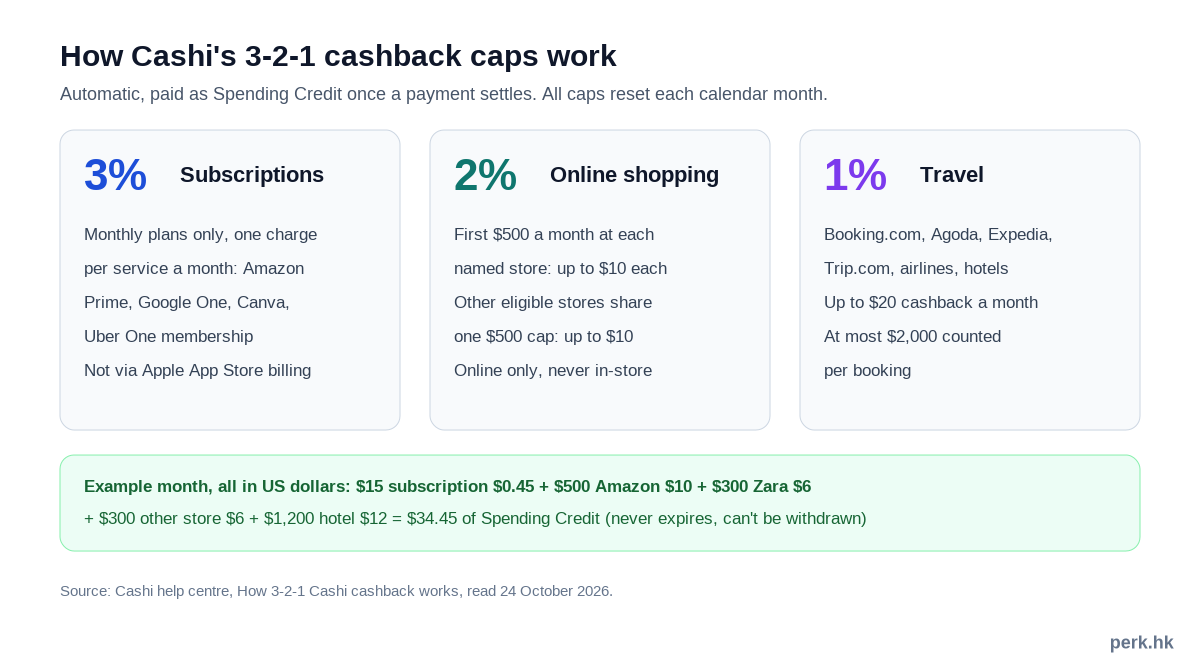
3% on subscriptions: monthly plans only, one charge per service per month, at Amazon Prime (including Prime Video on its own), Google One, Canva and Uber One. Annual plans earn nothing, nor do subscriptions billed through the Apple App Store, because Apple's charge does not show the service; pay the service directly or through Google Play.
2% online: online purchases only, never in store or by tap. At the named stores, including Amazon, AliExpress, ASOS, eBay, H&M, IKEA, Nike, Shein, Temu and Zara, the first US$500 spent at each store in a calendar month earns 2%, up to US$10 per store. All other eligible online stores share a single US$500 monthly cap, up to US$10 in total.
1% on travel: Booking.com, Agoda, Expedia and Trip.com, plus airlines and hotels booked directly, up to US$20 of cashback a month and counting at most US$2,000 of any one booking; hotel charges under US$20 do not qualify.
Nothing earns on cash withdrawals, transfers, trading or investments, gambling, gift cards, wallet top-ups, insurance, real estate, government payments, car rentals, cruises, taxis and rideshare, fuel, parking or public transport. Cashback shows as Pending at once and confirms when the payment settles, usually within a few days; you claim it on the Reward page as Spending Credit, and a refund reverses it.
A month in Hong Kong dollars
Assume US$1 = HK$7.80 and a household that shops online. In one month it spends US$500 (HK$3,900) at Amazon, charged in US dollars; HK$2,340 (US$300) at another named store that charges in Hong Kong dollars; HK$7,800 (US$1,000) on a hotel booked through Booking.com and charged in Hong Kong dollars; and HK$3,000 (about US$385) at local shops with Google Pay.
Cashback: US$10 at Amazon, US$6 at the second store and US$10 on the hotel, US$26 in all, or HK$202.80 of Spending Credit. Conversion fees: HK$23.40 on the store order, HK$78 on the hotel and HK$30 on the local shopping, HK$131.40 in all. The net gain is HK$71.40, and it arrives as credit that can only be spent on the card, while the fees come out of your balance.
Billed in US dollars, the store order and the hotel would have carried no fee, leaving only the HK$30 on local shopping and HK$172.80 net. The lesson for a Hong Kong cardholder: use Cashi for US dollar checkouts, and keep Hong Kong dollar spending, especially in shops, on another card.
Joining through our invite
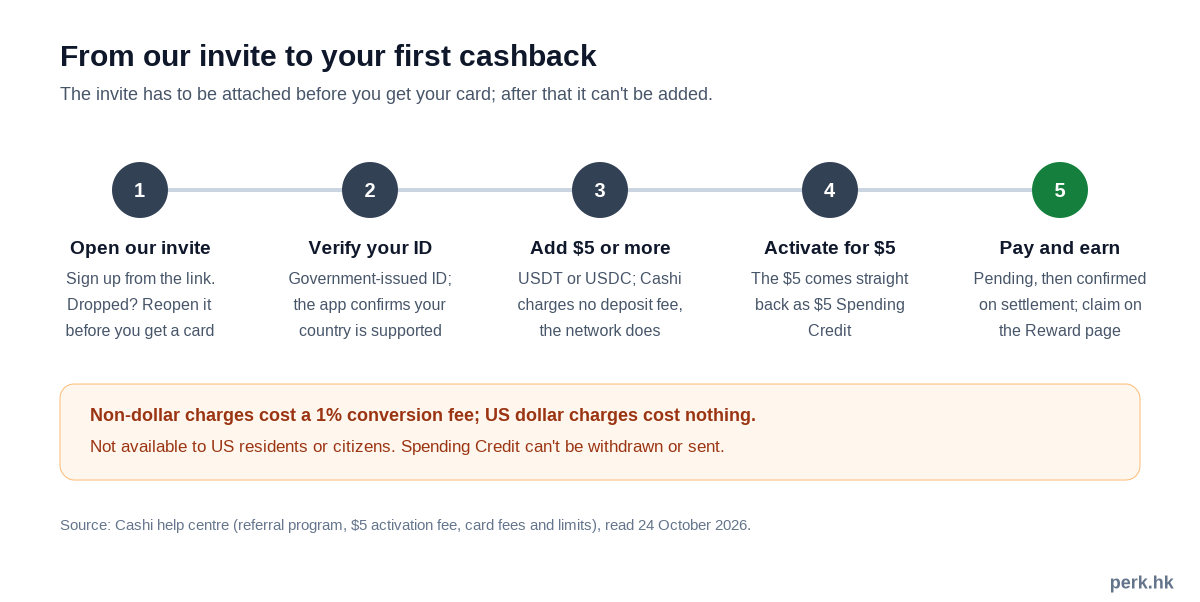
If you sign up through an invite on or after 1 November 2026, Cashi gives you US$5 of Spending Credit once your first US$50 of card purchases has settled; it appears on your Reward page, ready to claim. That is separate from the activation refund every new cardholder receives. At US$1 = HK$7.80, the US$50 threshold is HK$390 and the reward about HK$39; if those purchases are charged in Hong Kong dollars, the 1% conversion fee on them is about HK$3.90.
The invite must be attached before your card is issued. Sign up from our link; if the app loses the invite, reopen the link before you activate the card, and if Profile, then Referral, still shows no referrer, contact Cashi support before you get the card. Once you hold a card the invite can no longer be added, and a confirmed referrer cannot be changed. The invite on this page is ours.
There is no deadline for the US$50, but not every purchase counts. Cash withdrawals, sending money, top-ups of other cards or wallets, payments through payment links or money-collection services, Cashi fees (the activation fee included), declined payments and refunds do not count, nor do payments at a merchant that we, as your inviter, or two or more of our other invitees have also paid; Cashi's terms list a few more. If a qualifying purchase is later refunded, Cashi can take the US$5 back.
Ratings, and leaving Cashi
On 24 October 2026 Cashi was rated 2.7 from 133 reviews on Google Play, with more than 5,000 downloads, and 4.3 from only 6 ratings on the US App Store. The recurring complaints were deposits that took time to appear in the balance, a first payment that failed and then worked on a retry, and slow support; the praise was for easy setup and simple card management. With so few reviews, start with a small deposit.
The card cannot yet be closed permanently, only frozen. To leave, spend your Spending Credit first, since it cannot be withdrawn or transferred, then send your stablecoins to another wallet, paying only the network fee. If Cashi suspends or terminates an account, its terms say it will facilitate the withdrawal of remaining assets "where technically and legally feasible".
Who should apply, and who should not
Apply if the Cashi app confirms Hong Kong, you already hold USDT or USDC, and a good share of your spending is online at merchants that bill in US dollars, including monthly plans on the 3% list. Join through our invite before your card is issued, and start with a small deposit.
Look elsewhere if you need deposit protection, a physical card, cash withdrawals or Apple Pay, if most of your spending is in Hong Kong dollars at local shops, or if you are a US citizen. Do not convert Hong Kong dollars into stablecoins just to earn a few US dollars of Spending Credit.
FAQ
- Can Hong Kong residents open a Cashi account?
- Cashi does not say. It serves 100+ countries without publishing the list, and the app tells you during sign-up whether registration and the card are available where you live. Confirm that Hong Kong is offered before you transfer any money.
- What does a purchase in Hong Kong dollars cost?
- A 1% conversion fee on top of the exchange rate set by Cashi's conversion partner; at US$1 = HK$7.80, a HK$1,000 purchase costs about HK$10 more. Charges in US dollars carry no conversion fee, and Cashi lists no separate cross-border fee.
- Is my balance covered by Hong Kong's Deposit Protection Scheme?
- No. Cashi is not a bank, and its terms say your assets are not deposits and are not protected by any government deposit protection or compensation scheme. They also say the assets are held for you and are not available to Cashi's creditors.
- Is Cashi licensed in Hong Kong?
- Cashi Ltd. is incorporated in Hong Kong and its terms are governed by Hong Kong law, but the terms name no licence from the HKMA or the SFC. The only regulated affiliate named is GBP Payments Corp., registered with Canada's FINTRAC, and the card issuer is not named.
- What do I get by joining through the invite?
- US$5 of Spending Credit (about HK$39) once your first US$50 (HK$390) of card purchases has settled, for sign-ups on or after 1 November 2026. Attach the invite before the card is issued.
- Can I tap the card in Hong Kong shops?
- Only from an Android phone with the card in Google Pay. Apple Pay is on Cashi's roadmap, there is no physical card yet and no published ATM option. In-store spending earns no cashback either.
- Can I withdraw the cashback?
- No. It becomes Spending Credit, which never expires but can only be spent with the Cashi card.
Related offers

Provider
Startale
The Startale Card is issued by Rain's Third National, and Rain's card prohibitions exclude Mainland China but not Hong Kong. Startale publishes no static country list and checks eligibility at Rain's identity step. Join the Startale App with invite code KNEJGM36 to reserve a place with no deposit; virtual cards have opened in batches by rank since 2 November 2026. There is no joining bonus. The card pays 1% cashback in USDSC, while purchases outside US dollars can carry up to 1.5% FX and up to 1.5% cross-border fees.
Requirement: No deposit to reserve a place; USDSC is needed to use the card once invited
Easy5 minutes to reserve; the application takes about 5 minutes once invited, with review of up to 5 business daysPayout Invitations roll out in waves by queue rank; 1% cashback is paid in USDSC on settled purchases
Verified 20 November 2026

Provider
Solid
Hong Kong is on Solid's list of places where its card is available, and the free virtual Visa is issued by Wirex. Join with code 2SS2K and, within 30 days, verify, activate the card and spend US$150 on everyday purchases at 3 or more shops (US$10 or more at each) for US$10 in card credit; reach US$5,000 within 90 days for US$50 more. Card credit pays only for Solid card purchases and cannot be withdrawn. Purchases in Hong Kong dollars carry a 1.5% foreign-exchange cost built into the rate.
Requirement: Within 30 days of sign-up: verify, activate the card and spend US$150 at 3 or more shops (US$10 or more each) for US$10; US$5,000 within 90 days for another US$50
Medium15 to 30 minutes to open and verify; the qualifying spending takes longerPayout Card credit is added when each target is reached, after any review of up to 14 days
Verified 22 November 2026

Provider
RedotPay
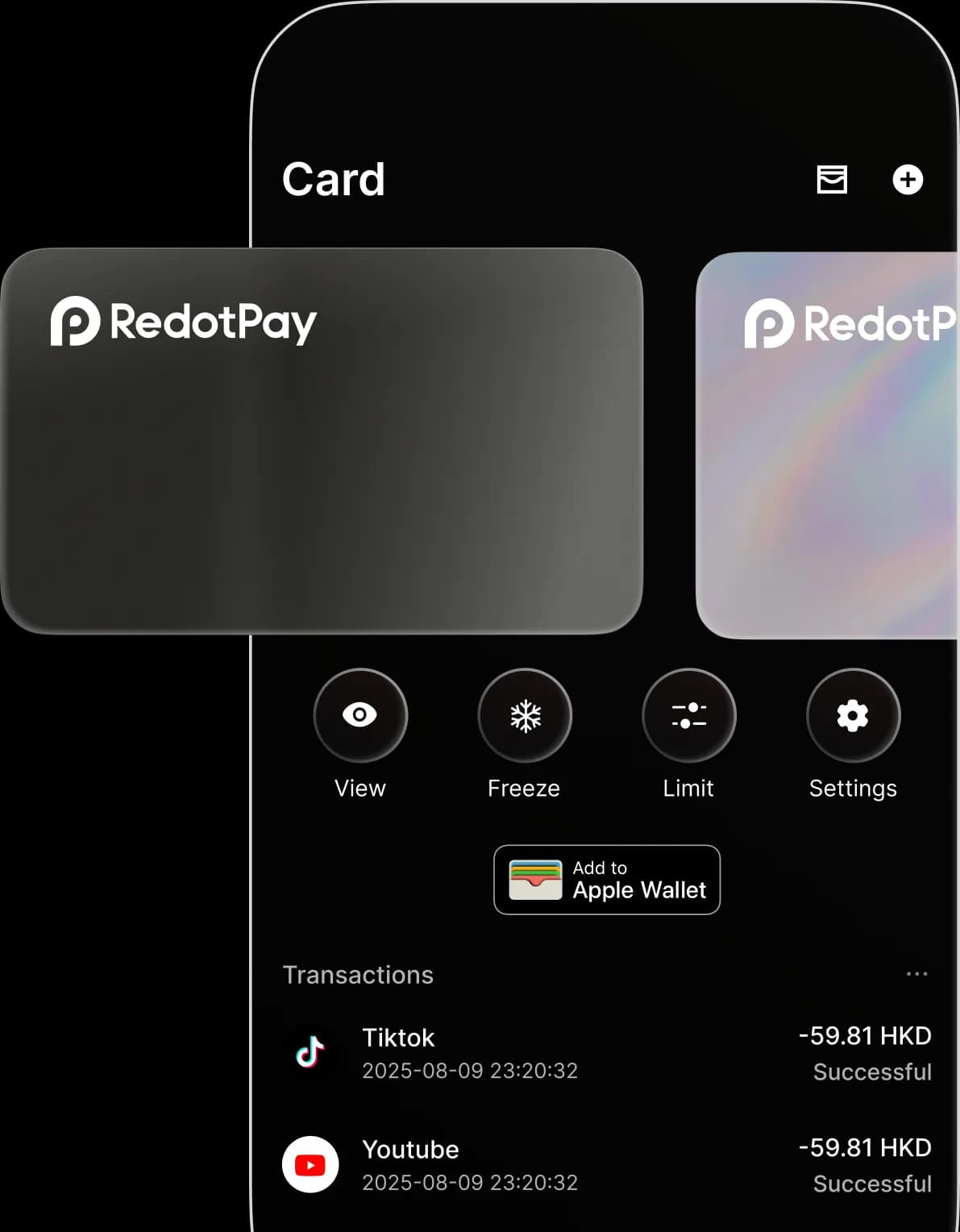
Hong Kong is not on RedotPay's card issuance restrictions, so Hong Kong residents can order its crypto-funded Visa card. Enter getquids on a virtual card order or getquidsp on a physical card order, before payment, and the one-off fee falls from US$10 to US$8 (about HK$62) or from US$100 to US$80 (about HK$624). Cards issued since 21 January 2026 are billed in US dollars, so purchases in Hong Kong dollars carry 1.2% plus the 1% crypto conversion fee, about 2.2%. RedotPay is a custodial app, not a bank, and balances are not covered by Hong Kong's Deposit Protection Scheme.
Requirement: No spending requirement: complete verification and hold enough balance for the discounted US$8 or US$80 fee before ordering
EasyAbout 5 to 10 minutes to register, verify and order; the virtual card is usable within minutes, and a physical card takes 5 to 30 days to reach Hong Kong by standard mail or 3 to 10 days by DHL ExpressPayout Immediate: the 20% discount is shown on the order screen before you confirm, and the reduced fee is deducted from the RedotPay balance when the card is issued
Verified 24 October 2026