

Nous Portal Review for Hong Kong: US$5 Plus, Usage Credits and Renewal
Assess the getquids first-invoice discount, USD credits, tools, cloud, privacy and cancellation before paying from Hong Kong.
Last updated 14 October 2026

Best for
Hong Kong users with real Hermes or multi-model work, who will manage dollar usage and renewal dates.
The invitation makes Plus a reasonable paid experiment if you have work ready to use it on: US$5 for the first month with US$22 service credit, rather than the usual US$20. It is not US$22 cash or unlimited inference. Models, tools and optional cloud draw on the balance, and Plus carries at most US$10 into the next cycle. Check the first invoice, use a payment card that has not backed another referral and cancel before the US$20 renewal if you only want the trial month. Start with the smallest plan; Super and Ultra have the same 10% credit uplift, not a better basic exchange rate.
Pros
- The verified invitation shows Plus at US$5 in month one, with US$22 service credit
- One Portal account covers a broad model catalogue, hosted tools and optional Hermes Cloud
- All three paid plans allocate 10% more usage credit than their advertised monthly price
- A model price catalogue lets you compare input and output costs before choosing
- The free tier exposes free models without a monthly credit allocation or paid subscription
- Privacy Mode provides controls over Nous's own inference-payload retention and training use, subject to stated exceptions
Watch-outs
- The first-month reduction ends after the first invoice; Plus renews at US$20/month
- Each payment card can back one referral, and previous referral use can reverse the discount
- Paid credit allocations are finite and rollover caps can leave unused allowance with less future value
- Hosted tools and cloud hosting are metered against the same balance, rather than unlimited inclusions
- The terms describe fees as non-refundable and before applicable taxes; Hong Kong dollar payment costs depend on your card
- Privacy Mode does not change upstream providers' policies and retains operational metadata and stated exceptions
Current related offer
Nous Portal offer pageAd / referral links — we may earn a bonus when you sign up.
Provider
Nous Portal
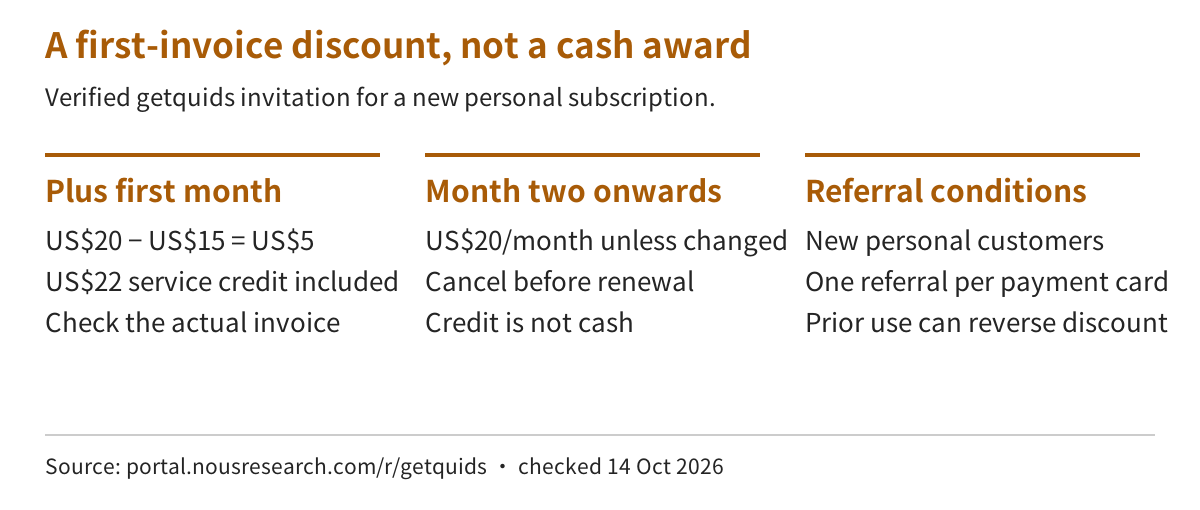
Our getquids invitation takes US$15 off a new personal subscription's first invoice. The page shows Plus at US$5 for the first month with US$22 usage credit, then US$20/month; check the discount in checkout and cancel before renewal if you only want a trial month.
Requirement: Plus first invoice US$5 after US$15 off; then US$20/month before applicable taxes or payment-provider currency costs
EasyA few minutes to register and inspect checkout; agent setup and verification varyPayout Discount on the first invoice, not a later cash payment; verify credited usage balance after subscribing
Verified 14 October 2026
Full claim instructions are on the Nous Portal offer page.
Portal is the service account; Hermes is the agent
Nous Portal connects a model catalogue, hosted tools and optional agent hosting through one account and balance. Hermes Agent is the software that uses those services to carry out work; paying for Portal does not mean every possible agent action has a fixed cost or unlimited access. The catalogue also includes other providers' models, with parts of its model access described as powered by OpenRouter.
The terms identify the operator as Nous Research, Inc., a Delaware corporation. Prices are in US dollars, so readers paying in another currency should check conversion rather than assume a local-currency subscription. The benefit is convenient access and centralised usage accounting. Its usefulness depends on the models, tools and agent tasks you actually need, not on accumulating the largest credit balance.
The US$15 invitation discount is a first-invoice saving
Our getquids invitation page says US$15 off the first month of a new personal subscription. It specifically displays Plus's usual US$20 reduced to US$5, with US$22 monthly credits, a US$10 rollover cap and US$20/month afterwards. Follow "Claim your invite" and check the discounted invoice before paying. We inspected the public claim journey without completing an account or a payment.
This is a price reduction, not a cash payment and not an additional US$15 on top of the US$22 allocation. It is for new customers on new personal subscriptions. One payment card can support one referral; the page says previous referral use reverses the discount and prevents the reward. Terms also exclude self-referrals and accounts you own/control. Disclosure: getquids is our invitation identifier and we may receive a referral benefit; no specific referrer amount was established by the public page.
Free, Plus, Super and Ultra compared
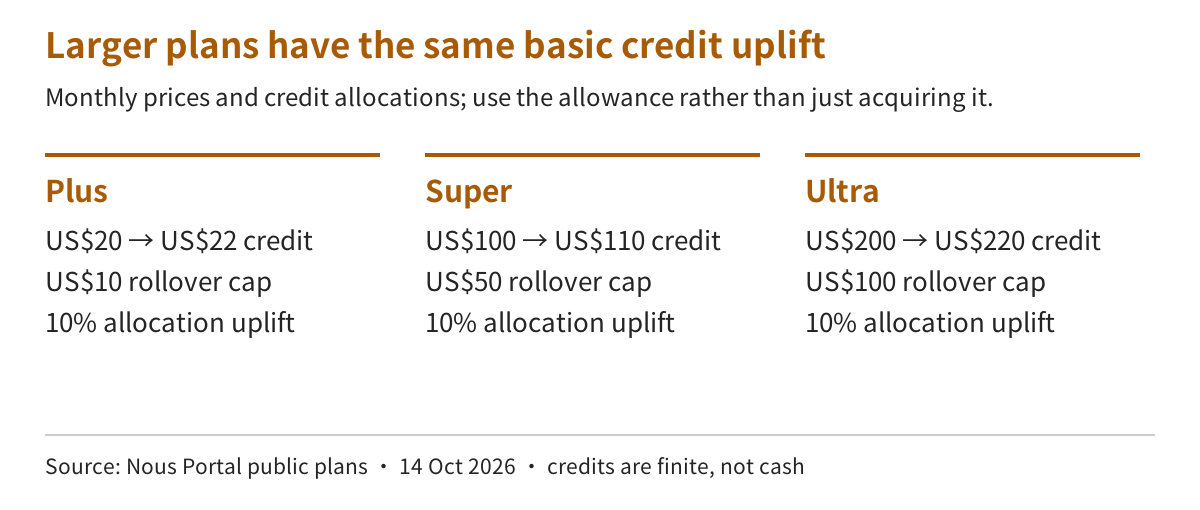
The public plan page lists Free at US$0 with free models only, standard limits and no monthly credits. Plus is US$20/month with US$22 credits and US$10 rollover; Super is US$100 with US$110 and US$50 rollover; Ultra is US$200 with US$220 and US$100 rollover. Paid tiers advertise model access, hosted tool use and higher limits. Check the actual rate limits for your task; a higher balance alone does not define them.
All three paid tiers have the same 10% allocation uplift. Once the invitation month ends, paying US$20 for US$22 of metered use is about a 9.09% effective saving against paying US$22 at face value, if you use it all. Super and Ultra do not improve that arithmetic; they buy more monthly allowance and a larger rollover cap. An occasional user should not pay US$100 merely to acquire five times the unused credit.
What a US$22 allowance can actually buy
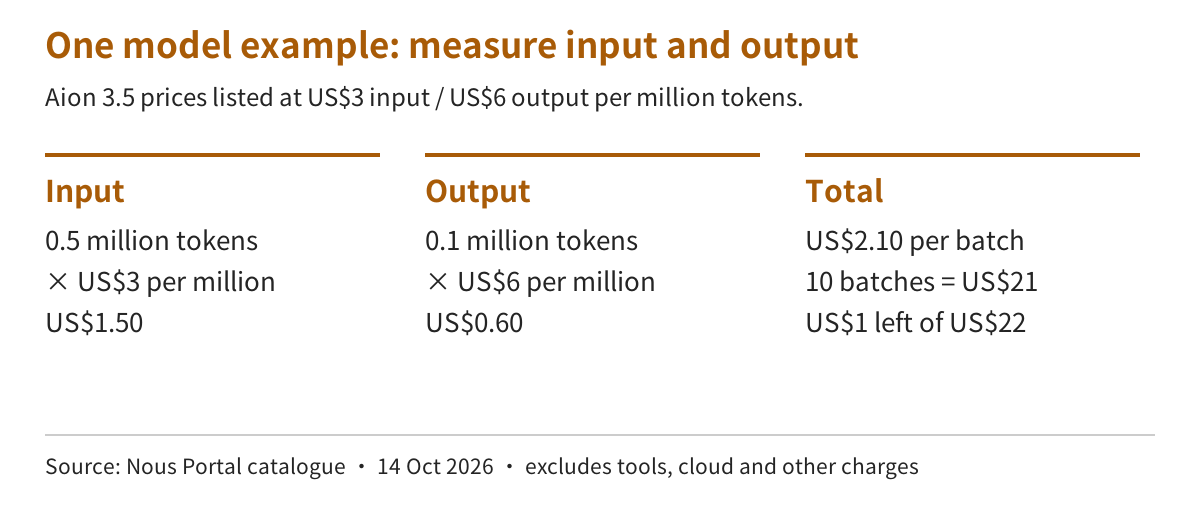
The homepage catalogue listed Aion 3.5 at US$3 per million input tokens and US$6 per million output tokens on 14 October. As an example, 500,000 input tokens plus 100,000 output tokens costs US$1.50 + US$0.60 = US$2.10. US$22 covers ten such batches, leaving US$1, before tools, hosting or any other charge. This is one model-price example, not a claim that every model costs the same.
Agent workflows can repeatedly send conversation context, read files and generate outputs, so a task can consume more than one apparent chat turn. Compare actual metered input/output usage, not the number of messages. A model free for a temporary campaign may change price later. Check your selected model's live rate and the usage screen before starting a long task, particularly after the cheap invitation month.
Hosted tools and cloud share the budget
The Portal overview explicitly says the Tool Gateway's search, scraping, image generation, browser and speech services bill by use to the same credits as models. Hermes Cloud's server costs also bill to that balance. A subscription's "Hosted tool usage" inclusion means access to metered services, not an unlimited separate pot.
Cloud charges can continue while an instance is provisioned, even when you are not asking the agent questions. Read the current size, price and stopping/deletion rules before deploying a server. Ending a chat or cancelling a subscription should not be assumed to remove every hosted resource. For a first trial, local Hermes use with a small model budget is easier to measure than adding always-on hosting immediately.
Rollover limits change the value of unused credit
Plus's published rollover cap is US$10. If US$18 of the month's allocation remains, no more than US$10 of it is within that advertised cap; you should not budget as though the whole US$18 is a permanent balance. Super and Ultra raise the cap to US$50 and US$100, respectively, while also increasing your recurring payment.
The public invitation does not settle every detail of credit expiry, top-up credit versus subscription allowance, or retention after downgrade/cancellation. Check these in billing before relying on carry-over. For someone who only uses US$6 of ordinary monthly service, a US$20 subscription can be poor value even though its allocation is labelled US$22. Separate the credit you will use from credit you are merely shown.
Privacy Mode is useful, with important limits
Nous's privacy policy, updated 28 September 2026, covers prompts, inputs, uploads, outputs, conversations, tool activity and usage metadata. In Account Settings, Privacy Settings, Privacy Mode limits Nous's storage and use of inference payloads for training, improvement and support, with stated security, operational and legal exceptions.
It does not stop required operational metadata or change another model/tool provider's policy, and may apply prospectively rather than undo earlier processing. Enable it before sensitive work and inspect the upstream providers you choose. An agent with file, browser or connected-account access can also send data through tools; review those permissions separately. This review did not test payload deletion or independently audit the retention controls.
Signing up, API access and practical friction
Start from the invitation, inspect the Plus price and create the personal account through that path. Verify the invoice and credited balance, then use the documented account/API setup for the client you intend to run. We inspected the claim page and public docs, but did not create an account, issue an API key or run a paid inference request.
Several public pages returned HTTP 429 to the automated research client, and a browser navigation also waited on background requests; those are observations of this research session, not proof that subscribers cannot use the service. A public Hermes GitHub report describes hosted-tool entitlement/authentication failures despite a paid plan. It is one report, not a failure rate. If access fails, record the model/tool, time, error and billing state, then use official support rather than repeatedly topping up without diagnosing the problem.
Hong Kong dollar payment, renewal and cancellation
The invite says Plus renews at US$20/month and may be cancelled anytime. Terms describe advance billing, non-refundable fees and applicable taxes separately. In Hong Kong, the actual HKD debit depends on conversion and card currency charges; US$5 is neither HK$5 nor a permanent monthly price.
Before paying, find the renewal date and cancellation control. Save the invoice and cancellation confirmation, stop unwanted cloud resources and export any data you need before downgrade or closure. The terms warn that a downgrade may reduce features or lose data. Stopping future renewal, refunding a fee and deleting the account are separate actions; cancellation wording does not establish that the already paid first month will be refunded.
Who should try it, and who should skip the paid month
The US$5 Plus month is a useful small experiment if you have actual Hermes or multi-model work to run, can inspect privacy and tool permissions, and will monitor usage and renewal. Choose a model based on the task and price, test a small run first and increase spend only once it gives you useful output.
Use Free first if you only want to explore available free models. Skip a paid plan if you are unlikely to use the allowance, need an unlimited flat-price service, or cannot use a payment card eligible for the referral. A bigger subscription is not justified by the same 10% uplift. The discount should lower the cost of testing a product you want, rather than create an ongoing bill for an idle agent.
FAQ
- Is US$15 the reward or the price?
- It is the discount on the first invoice. Plus is displayed at US$5 for month one, with US$22 usage credit; it then renews at US$20/month.
- Is the credit cash?
- No. It pays for supported service usage. It is separate from the US$15 price discount, and is not presented as a cash withdrawal.
- Does the referral apply to an existing or team plan?
- The invitation says new customers on a new personal subscription; existing subscriptions and team purchases are not established as eligible.
- What happens if I reuse a referral-linked payment card?
- Each card can back one referral. The page says previous use can reverse the discount and prevent the reward, so confirm eligibility before payment.
- Are tools and Hermes Cloud unlimited?
- No. Models, tools and optional hosting bill against the same balance at their rates. Your monthly allocation and rollover cap are finite.
- Does Ultra give a better credit multiplier?
- Plus, Super and Ultra all show a 10% allocation uplift. Ultra provides more allowance and a higher rollover cap, not a better basic ratio.
- Does Privacy Mode cover every provider?
- It governs Nous's own payload handling with stated exceptions. It does not change third-party model/tool policies or remove required operational metadata.
- Can I cancel after trying the US$5 month?
- Check the renewal date and cancel before the next invoice, saving confirmation. The terms describe fees as non-refundable; separately stop any cloud resources and preserve needed data.